class: center, middle name: title # CS 10C - Lists ![:newline] .Huge[*Prof. Ty Feng*] ![:newline] .Large[UC Riverside - SQ 2026] ![:newline 6]  .footnote[Copyright © 2026 Joël Porquet-Lupine and Ty Feng - [CC BY-NC-SA 4.0 International License](https://creativecommons.org/licenses/by-nc-sa/4.0/)] --- # Abstract Data Types ## Terminology ### Type - Collection of values - E.g.: boolean (`true`/`false`), int (`..., -1, 0, 1, ...`), float, etc. - Simple type: no subparts - Aggregate/composite type: record containing fields (`struct { ... }`) ??? - simple type: - aka trivial types or basic types or primitive types - essentially types the processor knows at hardware level -- ![:newline 0.5] ### Data type - Type and collection of operations to manipulate the type - E.g.: `+ - * /`, `== != < >`, etc. ??? - data type: also operations that are known at processor level -- ![:newline 0.5] ### Abstract data type (ADT) - Specification of data type, *independent of implementation* - E.g.: **list**, stack, queue, dictionary, set, etc. ??? - ADT is defined as a type and a set of operations on it - Doesn't define how it's implemented - Implementation is hidden to the user - Can be changed transparently (e.g. for efficiency reasons) - Why aren't `int`'s ADTs? - Can have different representations: binary most often as two's complement, but can be binary-coded decimal or in ones' complement. - However the abstraction isn't perfect: users must be aware of issues like arithmetic overflows which are due to the representation! - Difference between list and set - List has a notion of order via indexing - Set has no order but is focused on membership (is a value a member of the set): then union between two sets, intersection, difference, etc. -- ![:newline 0.5] ### Data structure - Implementation of an ADT - E.g.: array, singly linked list, doubly linked list, hash table, trees, etc. ??? Some of this terminology is not perfect: - e.g., types and data types are often interchangeable - however, ADTs and data structures are 100% correct! --- layout: true # The List ADT --- ## Definition .lcol75[ ![:newline 0.5] - Ordered collection of items of some type `T` ] .rcol25[  ] -- .wide[ ### Operations - Typical set of operations (*API*) ] ```C // Return number of items in list size_t Size(); // Return item at position @pos const T& Get(const size_t pos); // Return position of first occurence of @item (-1 if not found) int Find(const T &item); // Remove item at position @pos void Remove(const size_t pos); // Insert @item at position @pos void Insert(const T &item, const size_t pos); ``` -- ![:newline 1] - Many other operations are possible, depending on the context and requirements: `isEmpty()`, `pushFront()`, `popBack()`, etc. ??? - Ask how each of the other operations can actually be implemented with the basic operations -- .footnote[ \**Lists form the basis for other ADTs, such as stacks and queues (next lecture topic)* ] --- ## Typical implementations .lcol60[ - Most commonly as arrays (*fixed* or *dynamic*) ] .rcol40[ 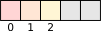 ] -- ![:flush 1] .lcol60[ - Or linked lists (*singly* or *doubly linked*) ] .rcol40[  ] -- ![:flush 1] .lcol60[ - But possibly even as trees! ] .rcol40[  ] ??? - Plenty of ways to implement the same ADT using various data structures! --- layout: true # Fixed array implementation --- .lcol[ ```C ListFixedArray<int> l; ``` ] .rcol[  ] -- ![:flush 1] .lcol[ ```C l.Insert(23, 0); ``` ] .rcol[  ] -- ![:flush 1] .lcol[ ```C l.Insert(42, l.Size()); ``` ] .rcol[  ] -- ![:flush 1] .lcol[ ```C l.Insert(99, 0); ``` ] .rcol[ 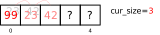 ] -- ![:flush 1] .lcol[ ```C l.Remove(1); ``` ] .rcol[ 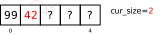 ] ??? - Important to notice that capacity does not change --- ## Data structure .lcol.small[ ```C template <typename T> class ListFixedArray { private: // Fixed capacity of 3 items static constexpr size_t capacity = 3; std::array<T, capacity> items; size_t cur_size = 0; ... }; ```  ] -- .rcol.small[ - `static` to make `capacity` exist without instantiating and `constexpr` to make it available to compiler - `std::array` is equivalent to a C-style array (`T items[capacity]`) - Member variables already initialized ] ??? - `std::array` - New since C++11 -- ![:flush 2] ## Constructor/destructor .lcol.small[ ```C public: ListFixedArray() = default; ~ListFixedArray() = default; ```  ] .rcol.small[ - `default` to have the compiler generate the corresponding constructor or destructor: - No initialization list - Empty compound statement ] ??? - `default` - New since C++11 --- ## List API (1/3) .small[ ```C size_t Size() { return cur_size; } ```  ] -- ![:newline 0.5] .small[ ```C const T& Get(const size_t pos) { if (pos >= cur_size) throw std::out_of_range("Position out of range!"); return items[pos]; } ```  ] -- ![:newline 0.5] .small[ ```C int Find(const T &item) { for (size_t i = 0; i < cur_size; i++) if (items[i] == item) return i; return -1; } ```  ] -- ![:newline 1] - What is the complexity of each function? --- ## List API (2/3) .small[ ```C void Remove(const size_t pos) { if (pos >= cur_size) throw std::out_of_range("Position out of range!"); for (auto i = pos + 1; i < cur_size; i++) items[i - 1] = items[i]; cur_size--; } ```  ] ![:newline 2] 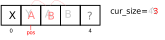 --- ## List API (3/3) .small[ ```C void Insert(const T &item, const size_t pos) { if (pos > cur_size) throw std::out_of_range("Position out of range!"); if (cur_size == capacity) throw std::overflow_error("List full!"); if (pos != cur_size) { // Move existing item(s) if insertion before them auto i = cur_size - 1; do { items[i + 1] = items[i]; } while (i-- != pos); } items[pos] = item; cur_size++; } ```  ] ![:newline 1] 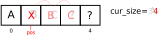 --- ## Conclusion Pros and cons? -- ![:newline 1] ### Pros - Implementation is straight forward - Little to no waste of memory space if number of items matches capacity of list on average -- ![:newline 1] ### Cons - Waste of space if list mostly empty - Really just an array, not an actual list - Insertion and removal operations are limited --- template: title --- layout: false # Recap .lcol[ ## List ADT - Ordered collection of items of some type `T`  ] .rcol[ ## Various implementations   ] ![:flush 0.5] .lcol55[ ## Fixed array implementation .tiny[ ```C template <typename T> class ListFixedArray { private: // Fixed capacity of 3 items static constexpr size_t capacity = 3; std::array<T, capacity> items; size_t cur_size = 0; public: ListFixedArray() = default; ~ListFixedArray() = default; // Return number of items in list size_t Size() { return cur_size; } ... }; ```  ] ] .rcol45[ ## Pros and cons - (+) Simple implementation - (-) No flexibility, doesn't fully implement the List API ] --- layout: true # Dynamic array implementation --- ## When to grow/shrink? ![:newline 1] ### Option #1: on each operation - `Insert()`: increase size of array by 1 - `Remove()`: decrease size of array by 1 -- ![:newline 0.5] #### Problem Resizing the array on each operation is too expensive! - Need to copy all items to new array, for each operation - To add first $n$ items, complexity would be $O(n^2)$ -- ![:newline 2] ### Option #2: Infrequently - Resizing must be a **rare** event - But without wasting too much extra memory space... --- ## Resizable data structure .lcol60.footnotesize[ ```C template <typename T> class ListDynamicArray { private: // Initial capacity of 3 items size_t capacity = 3; std::unique_ptr<T[]> items; size_t cur_size = 0; ... public: ListDynamicArray() : items(std::unique_ptr<T[]>(new T[capacity])) { } ~ListDynamicArray() = default; ... }; ```  ] .rcol40[ - `capacity` is no longer a constant - Smart pointer for array of items - Ensures list is sole owner of the array - Auto-destruction when list disappears ] ??? - Default destructor takes care of automatic deallocation -- .lcol60.footnotesize[ ```C // Resize array according to new capacity void Resize(size_t new_cap) { assert(new_cap && new_cap >= cur_size); std::unique_ptr<T[]> new_items(new T[new_cap]); std::move(items.get(), std::next(items.get(), cur_size), new_items.get()); std::swap(items, new_items); capacity = new_cap; } ```  ] .rcol40.small[ - `assert()` for checking internal invariants - Efficient data transfer from one array to another with `std::move()` - Efficient exchange of values between smart pointers with `std::swap()` ] --- ## Growing strategy - If array is full, create a new array of **twice** the size and copy items .footnotesize[ ```C void Insert(const T &item, const size_t pos) { ... // Grow by 2 when reaching max capacity if (cur_size == capacity) Resize(2 * capacity); ... } ```  ] --- ## Growing strategy: complexity analysis **Example:** insert $(n+1)$ items at the end of list ![:newline 1] ### Usual Big-O analysis For one insertion: - Best case (*array still has room*): $O(1)$ - Worst case (*array has to be expanded first*): $O(N)$ - Average case (*?*): $?$ ![:newline 1] How can we be more precise and offer more guarantee? ??? - Worst-case is too pessimistic -- ![:newline 1] ### Amortized analysis - $n$ operations take constant time: $O(1)$ - Last operation takes linear time: $O(n)$ - Total time: $T(n+1)=nO(1)+O(n)$ ![:newline 1] - *Amortized* time complexity for one operation: $$$\frac{nO(1)+O(n)}{n+1}=O(1)$$$ ??? - Best case is the norm - Worst case happens infrequently --- ## Shrinking strategy - Halve the array when array is *one-half* full? -- ![:newline 1] ### Problem Too expensive for (possible) worst-case scenario: - Push-pop-push-... sequence when array is full - Each operation takes linear time 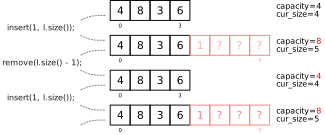 --- ## Shrinking strategy - Halve the array when array is **one-quarter** full .footnotesize[ ```C void Remove(const size_t pos) { ... // Shrink by 2 when reaching 25% of capacity if (cur_size <= capacity / 4) Resize(capacity / 2); } ```  ] --- ## Conclusion Pros and cons? -- ![:newline 1] ### Pros - Full implementation of the List ADT - Efficient indexing: $O(1)$ - Efficient insert/remove at end: $O(1)$ *amortized* ??? - Indexing is `Get()` -- ![:newline 1] ### Cons - Implementation is more complex - Some waste of space - Array is always between 25% and 100% full - Inefficient insert/remove at beginning/middle: $O(N)$ --- template: title --- layout: false # Recap ## Fixed array implementation .lcol55[ .tiny[ ```C template <typename T> class ListFixedArray { private: // Fixed capacity of 3 items static constexpr size_t capacity = 3; std::array<T, capacity> items; size_t cur_size = 0; ... }; ```  ] ] .rcol45[ ### Pros and cons .small[ - (+) Simple implementation - (-) No flexibility, doesn't fully implement the List API ] ] -- ![:flush 1] ## Dynamic array implementation .lcol60[ .tiny[ ```C template <typename T> class ListDynamicArray { private: // Initial capacity of 3 items size_t capacity = 3; std::unique_ptr<T[]> items; size_t cur_size = 0; // Resize array according to new capacity void Resize(size_t new_cap) { assert(new_cap && new_cap >= cur_size); std::unique_ptr<T[]> new_items(new T[new_cap]); std::move(items.get(), std::next(items.get(), cur_size), new_items.get()); std::swap(items, new_items); capacity = new_cap; } ... }; ```  ] ] .rcol40[ ### Pros and cons .small[ - (+) Efficient indexing ($O(1)$) - (+) Efficient operations at end ($O(1)$ *amortized*) ![:newline] - (-) Inefficient operations at beginning/middle ($O(N)$) - (-) Possible waste of space ] ] --- # Linked list [](https://www.youtube.com/watch?v=KqTVkUxMUi8)  --- layout: true # Singly linked list implementation --- .lcol[ ```C ListSinglyLinked<int> l; ``` ] .rcol[  ] ??? - Head of the list points on NULL, list is empty -- ![:flush 1] .lcol[ ```C l.Insert(23, 0); ``` ] .rcol[  ] ??? - Insert first value - Head points on node containing this value - Node has the value, next pointer to NULL -- ![:flush 1] .lcol[ ```C l.Insert(42, l.Size()); ``` ] .rcol[  ] ??? - Insertion at end of the list - Nodes points onto new node - Node has the value, next pointer to NULL -- ![:flush 1] .lcol[ ```C l.Insert(99, 0); ``` ] .rcol[  ] ??? - Insertion at front of the list - Head points onto new node - Node has the value, next pointer to previous first node -- ![:flush 1] .lcol[ ```C l.Remove(1); ``` ] .rcol[  ] ??? - Removal middle - Rewire next pointer to bypass deleted node - Remove node's memory --- ## Data structure .lcol60.footnotesize[ ```C template <typename T> class ListSinglyLinked { private: struct Node { T item; std::unique_ptr<Node> next; }; std::unique_ptr<Node> head = nullptr; size_t cur_size = 0; ... public: ListSinglyLinked() = default; ... ~ListSinglyLinked() = default; ... }; ```  ] .rcol40[ - Internal node structure: data and next pointer - Use of smart pointers for ensuring sole ownership ] ??? - Domino effect when list gets destroyed. `head` causes first node to be destroyed, `next` of the first node causes second node to be destroyed, and so on. -- .lcol60.footnotesize[ ```C Node* GetNode(size_t pos) { assert(pos < cur_size); Node *n = head.get(); while (pos--) n = n->next.get(); return n; } ```  ] .rcol40[ - Internal `get()` method for access to any node in linked list - Use of regular pointer because list traversal is not about ownership ] ??? - What's the complexity of `GetNode()`? --- ## List API (1/3) .small[ ```C size_t Size() { return cur_size; } ```  ] -- .small[ ```C const T& Get(const size_t pos) { if (pos >= cur_size) throw std::out_of_range("Position out of range!"); auto n = GetNode(pos); return n->item; } ```  ] -- .small[ ```C int Find(const T &item) { int i = 0; for (auto n = head.get(); n; n = n->next.get(), i++) if (n->item == item) return i; return -1; } ```  ] ??? - Live quiz for complexities! --- ## List API (2/3) .small[ ```C void Remove(const size_t pos) { if (pos >= cur_size) throw std::out_of_range("Position out of range!"); if (!pos) { // Remove from top of list auto n = std::move(head); head = std::move(n->next); } else { // Remove after existing item(s) auto prev = GetNode(pos - 1); auto n = std::move(prev->next); prev->next = std::move(n->next); } cur_size--; } ```  ] .small[ - Transfer node's ownership to local smart pointer variable `n` with `std::move()` - Automatically destroyed when goes out of scope ![:newline 0.5] - Because singly linked list, need to get hold of previous node to remove specified node *(not the case with doubly linked lists)* .rcol[  ] ] --- ## List API (3/3) .small[ ```C void Insert(const T &item, const size_t pos) { if (pos > cur_size) throw std::out_of_range("Position out of range!"); auto n = std::unique_ptr<Node>(new Node); n->item = item; if (pos == 0) { // Insert in front n->next = std::move(head); head = std::move(n); } else { // Insert after existing item(s) auto prev = GetNode(pos - 1); n->next = std::move(prev->next); prev->next = std::move(n); } cur_size++; } ```  ] .small[ - Usual singly linked list insertion - Change head pointer for insertion at beginning - Change previous node for insertion at middle or end ] --- ## Conclusion Pros and cons? -- ![:newline 1] ### Pros - Fairly simple implementation - Insert/remove at beginning: $O(1)$ -- ![:newline 1] ### Cons - Inefficient indexing: $O(N)$ - Inefficient insert/remove at middle/end: $O(N)$ - Only forward traversal * E.g., what would be the complexity of potential API function `reverseFind()`? ??? - Live quiz on reverseFind --- layout: true # Doubly linked list implementation --- ## Pointer to previous node - Efficient reverse traversal - Easier removal of a node ![:newline 1]  -- ![:newline 2] ## Optimization: pointer to tail - Efficient insert/remove at end - *(Can also be used in singly linked list implementation)* ![:newline 1]  --- ## Conclusion Pros and cons? -- ![:newline 1] ### Pros - Efficient insert/remove at end: $O(1)$ - Possibility of reverse traversal if required by API -- ![:newline 1] ### Cons: - Slightly more complex than singly linked list for insertion --- layout: false # Comparison of data structures .ref[\*] ![:newline 2] .footnotesize[ | Operation | Fixed array | Dynamic array | Linked list | |----------------------------|-------------|--------------------|------------------------------| | Random access | $O(1)$ | $O(1)$ | $O(N)$ | | Insert/Remove at beginning | N/A | $O(N)$ | $O(1)$ | | Insert/Remove at end | N/A | $O(1)$ *amortized* | $O(1)$ (with *tail* pointer) | | Insert/Remove at middle | N/A | $O(N)$ | $search time + O(1)$ | | Wasted space | $O(1)$ | $O(N)$ | $O(N)$ | ] .footnote[.ref[\*] Big-O only indicates how performance degrades as $N$ increases; actual comparison between data structures can also depend on other factors... (stay tuned)] --- layout: true # Standard C++ containers --- The C++ Standard Library defines two **popular** implementations of the list ADT (a.k.a. *sequence containers*): .lcol75[ - `std::vector` - Internally based on a dynamic array - *"Unless you have a solid reason not to, use a vector" (Stroustrup, 2013)* ] .rcol25[  ] .lcol75[ - `std::list` - Internally based on a doubly linked list ] .rcol25[  ] -- ![:flush 1] And two other **less popular** implementations: .lcol75[ - `std::forward_list` - Internally based on a singly linked list - (Good for empty and very short sequences) ] .rcol25[  ] .lcol75[ - `std::deque` - Double-ended queue - Internally based on an array of fixed-size arrays - (Good at growing in both directions) ] .rcol25[ 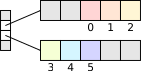 ] ??? - forward_list: surprisingly many uses for empty or short sequences (eg list all lastnames of class students by first letter) * In WQ25, no last names starting with E, O, Q, R, U, W - "deque" is pronounced "deck" --- ## Vector .lcol75.footnotesize[ ```C #include <iostream> #include <vector> int main() { std::vector<int> v = {7, 5, 16, 8}; // Direct [] access to values v[1] = 10; // Insert at beginning and middle v.insert(v.begin(), 42); v.insert(v.begin() + v.size() / 2, 23); // Insert at end v.push_back(25); v.push_back(13); // Remove last element v.pop_back(); // Iterate and print values for (auto n : v) std::cout << n << std::endl; return 0; } ```  ] .rcol25.small[ Execution: ```terminal 42 7 23 10 16 8 25 ``` ] --- ## List .lcol75.footnotesize[ ```C #include <algorithm> #include <iostream> #include <list> int main() { std::list<int> l = { 7, 5, 16, 8 }; // Add an integer to the front of the list l.push_front(25); // Add an integer to the back of the list l.push_back(13); // Insert an integer before 16 by searching auto it = std::find(l.begin(), l.end(), 16); if (it != l.end()) { l.insert(it, 42); } // Iterate and print values of the list for (auto n : l) { std::cout << n << std::endl; } } ```  ] .rcol25.small[ Execution: ```terminal 25 7 5 42 16 8 13 ``` ] --- .lcol[ ## Vector vs List - Insertion of random integers in collection - Keep collection sorted 1. Find proper location 1. Insert new integer ![:newline 0.5] - Based on complexity analysis, which container should perform better? ] ??? - Find proper location * O(N) for both containers - Insert value at location * O(1) for list * O(N) for vector -- .rcol[ ### Measurements 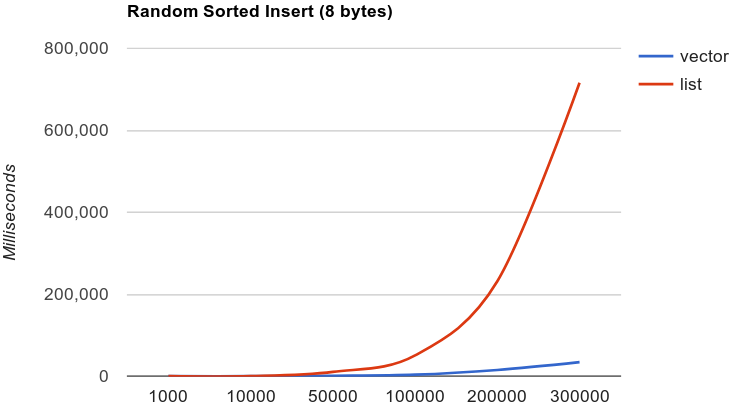 ] -- ![:flush 1] .small[ ### Explanation - `std::vector`'s internal array is stored contiguously in memory - Much of the array can be cached in processor resulting in very fast access - `std::list`'s nodes are typically not contiguous in memory - Causes lots of physical transfer between processor and RAM memory ### Conclusion - `std::vector` is generally faster and more efficient than `std::list` *(except when dealing with big items)*.ref[\*] ] .footnote[.ref[\*] More benchmarks: <https://baptiste-wicht.com/posts/2012/11/cpp-benchmark-vector-vs-list.html>]