class: center, middle name: title # CS 10C - Balanced trees ![:newline] .Huge[*Prof. Ty Feng*] ![:newline] .Large[UC Riverside - SQ 2026] ![:newline 6]  .footnote[Copyright © 2026 Joël Porquet-Lupine and Ty Feng - [CC BY-NC-SA 4.0 International License](https://creativecommons.org/licenses/by-nc-sa/4.0/)]  --- layout: true # Recap on BST --- ## Height of tree .lcol[ 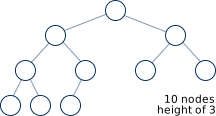 ] .rcol[ The height $h$ of a *complete* binary tree with $N$ nodes is at most $O(\lg N)$ ] -- ![:flush 3] ### Proof (kind of) Considering a perfect binary tree of height $h$ - Each level has exactly twice as many nodes as the previous level - The first level has only one node (the *root* node) - The total number of nodes is equal to the sum of the nodes on all levels $$$N = 1 + 2 + 4 + 8 + ... + 2^h = 2^{h+1} - 1$$$ - The height is therefore $$$h = \log_2(N + 1) - 1 = O(\lg N)$$$ ??? - x = log2(n) <=> 2^x = n - Solution * $2^{h+1} - 1 = N$ * $2^{h+1} = N + 1$ * $h+1 = \lg(N + 1)$ * $h = \lg(N + 1) - 1$ --- ## Complexity .lcol[ - Most BST operations are $O(h)$ - Complexity of $O(\lg N)$ if BST is *balanced* ] .rcol[ 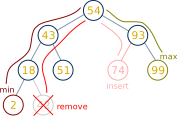 ] -- ![:flush 1] ## Conclusion - If BST is guaranteed to stay balanced, the worst-case complexity is guaranteed to be $O(\lg N)$ - So, how do we make a BST stay balanced? --- layout: false class: small # Ideas .lcol[ ## Same population from root? - Maintain same number of nodes on each side of root - But... 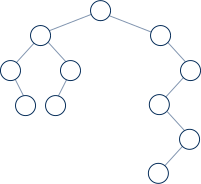 ] ??? - So, what does it mean for a tree to stay balanced? ![:newline 1] - Doesn't force tree to be balanced internally on either side - Here, difference in heights -- .rcol[ ## Same height from root? - Maintain same height on each side of root - But... 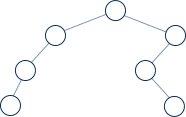 ] ??? - Same height, but still not balanced -- .lcol[ ## Same height for each node? - For each node, maintain same height in left and right subtrees - But... 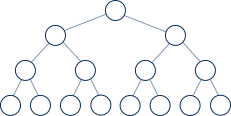 ] ??? - Only perfect trees can respect this condition! -- .rcol[ ## Requirements Must find a good **balance condition** - Easy to maintain - Depth of BST stays $O(\lg N)$ - Not too rigid ] ??? - In this class, we will focus on four balanced trees * AVL and RB trees, which are both great options for in memory trees * B-trees, great option for on-disk trees * Splay trees in discussion next week --- layout: true # AVL trees --- ## Definition - Published in 1962, by **A**delson-**V**elskii and **L**andis - *First self-balancing BST data structure to be invented* ![:newline 1] - AVL trees are height-balanced binary search trees - For each node, the height of its left subtree and the height of its right subtree can differ by **at most** 1 - Such difference value is called the node's *balance factor* ??? - Over 60 years ago -- ![:newline 1] ### Example 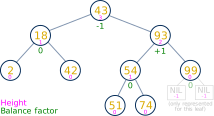 --- ## Non-AVL trees For each node: - Determine its height - Determine its balance factor - If balance factor is not -1, 0 or 1, then tree is not AVL ![:newline 2] ### Examples .lcol[ 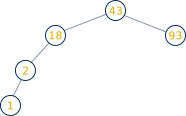 ] .rcol[ 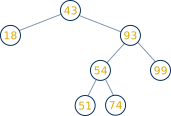 ] ??? - First tree - balance factor at node 18: +2 - balance factor at node 43: +2 - Second tree - balance factor at node 43: -2 ![:newline 2] - Live quiz! --- ## Operations .lcol[ - Query operations stay unchanged - `Contains()`, `Min()`, `Max()` - But worst-case complexity is now $O(\lg N)$! - Because AVL trees are guaranteed to be height-balanced ] .rcol[ 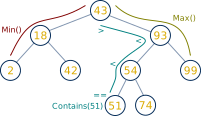 ] -- ![:flush 2] .lcol[ - Operations that *could* alter the balance of the tree must be slightly modified - `Insert()`, `Remove()` - Rebalancing after insertion or removal if balance condition is broken ] .rcol[ 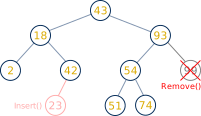 ] --- ## Simple rebalancing .lcol.small[ - Regular BST (*recursive*) insertion into AVL tree 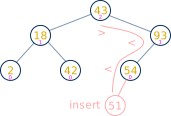 ] -- .rcol.small[ - **Retracing**: check every ancestor's balance factor 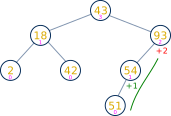 ] ??? - As we will see later, there are different scenarios we need to deal with - Here, we notice that both balance factors have same sign (+1 and +2), which tells us how to fix the problem -- ![:flush] .lcol.small[ - Swap unbalanced parent with "heavy" child through rotation 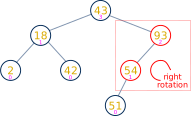 ] -- .rcol.small[ - Tree is back to being AVL 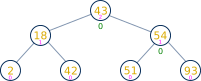 ] --- ## Single rotation right - Imbalance caused by either - Height decrease in subtree W (removal) - Height increase in subtree T (insertion) - Need a *right rotation* to rebalance left-heavy tree - $O(1)$ operation .lcol[ ### Before 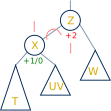 ] -- .rcol[ ### After 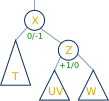 ] --- ## Single rotation left - Imbalance caused by either - Height decrease in subtree T (removal) - Height increase in subtree W (insertion) - Need a *left rotation* to rebalance right-heavy tree - $O(1)$ operation .lcol[ ### Before 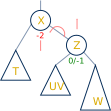 ] -- .rcol[ ### After 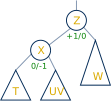 ] --- template: title --- layout: false # Recap .lcol[ ## AVL trees - Concept of balance factor  ] .rcol[ ### Query ops - Unchanged query operations - Guaranteed $O(\lg(N))$  ] -- ![:flush 1] ### Simple rebalancing .lcol[ - Solved by a single rotation  ] .rcol[  ] ??? - Imbalance caused by insertion: +1 at node 54, +2 at node 93 - Last time, started studying concepts - Today, finish concepts and start with C++ implementation --- layout: true # AVL trees --- ## Complex rebalancing .lcol.small[ - Retracing shows imbalance; but child's balance factor has *opposite* sign 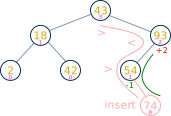 ] ??? - Show on blackboard what would happen with right rotation (like we solved the imbalance from previous example) -- .rcol.small[ - Need to first rotate child with heavy grandchild 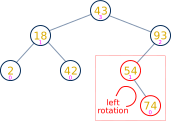 ] -- ![:flush] .lcol.small[ - Only then rotate unbalanced parent with heavy child 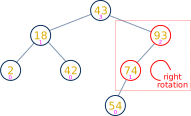 ] -- .rcol.small[ - Tree is back to being AVL 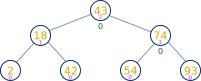 ] --- .lcol[ ## Double rotation: left-right .small[ - Imbalance caused by either - Insertion of node Y - Height decrease in subtree W - Height increase in subtrees U or V - Inner child Y of X is deeper than T - Need a *left rotation* to rebalance inner right-heavy subtree - Followed by a *right rotation* to rebalance left-heavy tree ] ] .rcol[ ### Before 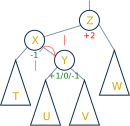 ] -- .lcol[ ### During 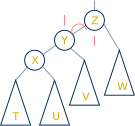 ] -- .rcol[ ### After 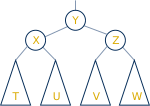 ] --- .lcol[ ## Double rotation: right-left .small[ - Imbalance caused by either - Insertion of node Y - Height decrease in subtree T - Height increase in subtrees U or V - Inner child Y of Z is deeper than W - Need a *right rotation* to rebalance inner left-heavy subtree - Followed by a *left rotation* to rebalance right-heavy tree ] ] .rcol[ ### Before 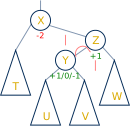 ] -- .lcol[ ### During 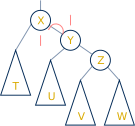 ] -- .rcol[ ### After  ] --- layout: true # AVL trees --- ## Implementation: data structure - Based on BST, unchanged for all *query* methods - `Contains()`, `Min()`, `Max()` - Node structure increased to contain the height information - A few extra internal methods for self-balancing purposes -- ![:newline 1] .lcol60.footnotesize[ ```C template <typename T> class AVL { ... struct Node{ T key; int height; std::unique_ptr<Node> left; std::unique_ptr<Node> right; }; std::unique_ptr<Node> root; ... // Helper methods for the self-balancing int Height(Node *n); void RotateRight(std::unique_ptr<Node> &prt); void RotateLeft(std::unique_ptr<Node> &prt); void Retrace(std::unique_ptr<Node> &n); }; ```  ] ??? - `prt` stands for "parent" -- .rcol40.small[ ```C template <typename T> int AVL<T>::Height(Node *n) { // NIL nodes if (!n) return -1; // Regular nodes return n->height; } ```  ] ??? - The `return -1` in method `height()` is how NIL nodes are represented --- ## Implementation: right rotation .small[ ```C template <typename T> void AVL<T>::RotateRight(std::unique_ptr<Node> &prt) { std::unique_ptr<Node> chd = std::move(prt->left); prt->left = std::move(chd->right); prt->height = 1 + std::max(Height(prt->left.get()), Height(prt->right.get())); chd->right = std::move(prt); chd->height = 1 + std::max(Height(chd->left.get()), Height(chd->right.get())); prt = std::move(chd); } ```  ] .lcol[ ### Before  ] -- .rcol[ ### After  ] --- ## Implementation: left rotation .small[ ```C template <typename T> void AVL<T>::RotateLeft(std::unique_ptr<Node> &prt) { std::unique_ptr<Node> chd = std::move(prt->right); prt->right = std::move(chd->left); prt->height = 1 + std::max(Height(prt->right.get()), Height(prt->left.get())); chd->left = std::move(prt); chd->height = 1 + std::max(Height(chd->right.get()), Height(chd->left.get())); prt = std::move(chd); } ```  ] .lcol[ ### Before  ] .rcol[ ### After 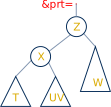 ] --- ## Implementation: insert/remove - Same body as BST - Additional **retracing step** on the way back from the recursion .footnotesize[ ```C template <typename T> void AVL<T>::Insert(std::unique_ptr<Node> &n, const T &key) { if (!n) n = std::unique_ptr<Node>(new Node{key}); else if (key < n->key) Insert(n->left, key); ... Retrace(n); } ... template <typename T> void AVL<T>::Remove(std::unique_ptr<Node> &n, const T &key) { // Key not found if (!n) return; if (key < n->key) { Remove(n->left, key); } else if (key > n->key) { ... Retrace(n); } ```  ] --- ## Implementation: retracing .footnotesize[ ```C template <typename T> void AVL<T>::Retrace(std::unique_ptr<Node> &n) { if (!n) return; if (Height(n->left.get()) - Height(n->right.get()) > 1) { // Tree is left heavy: need rebalancing if (Height(n->left->left.get()) < Height(n->left->right.get())) // Left subtree is right heavy: need double rotation RotateLeft(n->left); RotateRight(n); } else if (Height(n->right.get()) - Height(n->left.get()) > 1) { // Tree is right heavy: need rebalancing if (Height(n->right->right.get()) < Height(n->right->left.get())) // Right subtree is left heavy: need double rotation RotateRight(n->right); RotateLeft(n); } // Adjust node's height n->height = 1 + std::max(Height(n->left.get()), Height(n->right.get())); } ```  ] --- ## Testing (1): insertion of ordered values .lcol75.footnotesize[ ```C std::vector<int> keys{2, 18, 42, 43, 51, 54, 74, 93, 99}; AVL<int> avl; for (auto i : keys) { avl.Insert(i); avl.Print(); } ```  ] .lcol75.footnotesize[ ```terminal 2 (1) 2 (1) 18 (2) 2 (2) 18 (1) 42 (2) 2 (2) 18 (1) 42 (2) 43 (3) 2 (2) 18 (1) 42 (3) 43 (2) 51 (3) 2 (3) 18 (2) 42 (3) 43 (1) 51 (2) 54 (3) 2 (3) 18 (2) 42 (3) 43 (1) 51 (3) 54 (2) 74 (3) 2 (3) 18 (2) 42 (3) 43 (1) 51 (3) 54 (2) 74 (3) 93 (4) 2 (3) 18 (2) 42 (3) 43 (1) 51 (3) 54 (2) 74 (4) 93 (3) 99 (4) ``` ] ??? - Would degenerate into a list with simple BST --- ## Testing (2): 100 random pairs of insertion/deletion .lcol75.footnotesize[ ```C std::mt19937 rng(0); // Create uniform distribution of numbers std::uniform_int_distribution<int> distr(0, 99); // Insert and delete 100 times for (int i = 0; i < 100 ; i++) { // Insert random key that is not already in AVL int rval; do { rval = distr(rng); } while (avl.Contains(rval)); avl.Insert(rval); keys.push_back(rval); // Remove existing random key from the AVL std::shuffle(keys.begin(), keys.end(), rng); avl.Remove(keys.back()); keys.pop_back(); } // AVL should still be balanced avl.Print(); ```  ] .lcol75.footnotesize[ ```terminal 12 (3) 24 (4) 28 (2) 39 (3) 41 (4) 48 (1) 77 (3) 78 (2) 94 (3) ``` ] --- ## Conclusion ### Average and worst-case running times .center[ | Search | Insert | Delete | Find min/max | |-------------|-------------|-------------|--------------| | $O(\lg N)$ | $O(\lg N)$ | $O(\lg N)$ | $O(\lg N)$ | ] ![:newline 1] ### Characteristics - Very efficient for lookups because tightly balanced - At most, height of $1.440 \log_2(N + 2) - 1.328 \approx 1.44 \lg N$ - But rigid balancing can potentially slow down insertions and removals ??? - Wikipedia defines the height as $1.44 lg(N+2) - 0.328$ because it does not have the same definition of height as Weiss' book - A one tree node with Wikipedia is of height 1 - A one tree node with Weiss is of height 0 --- template: title --- layout: false # Recap .lcol[ ## AVL trees - Self-balancing tree structure - Concept of balance factor ] .rcol[  ] .lcol[ ![:newline 2] .lcol[ #### Right rotation  ] .rcol[ #### Left rotation  ] .lcol[ #### Left-Right rotation  ] .rcol[ #### Right-Left rotation  ] ] .rcol[ ![:newline 2] ### Conclusion - Very tightly balanced * $1.44 \lg N$ * Great for lookups * Slowish insertion/removal ![:newline 1] .tiny.center[ | Search | Insert | Delete | Find min/max | |-------------|-------------|-------------|--------------| | $O(\lg N)$ | $O(\lg N)$ | $O(\lg N)$ | $O(\lg N)$ | ] ] ??? - Past two lectures, studied AVL trees - Now, the other most popular type of self-balanced BST --- layout: true # Red-black trees --- ## Definition - Principle invented in 1972 by Bayer - Actual RB trees published in 1978 by Guibas and Sedgewick ![:newline 1] - Red-black trees are binary search trees with specific properties: 1. Each node is either colored red or black (**color rule**) 1. The root node is always black (**root rule**) 1. If a node is red, then both its children are black (**red rule**) 1. Every path from the root to any nodes of degree 0 or 1 must contain the same number of black nodes (**path rule**) ![:newline 1] .lcol25[ ### Example ] .rcol75[ 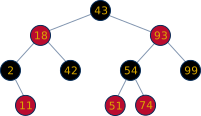 ] ??? - Sedgewick worked on quicksort - didn't invent it, that's Hoare, but helped improving it ![:newline 1] - Live quiz! --- ## Remarkable examples .lcol[ 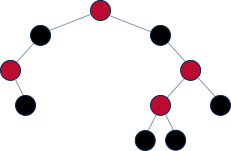 ] -- .rcol[ ### Non-RB tree All three rules are violated: 1. Root is not black 1. A red node has a red child 1. Path to red node in left subtree has only one black node ] -- ![:flush 1] .lcol[ 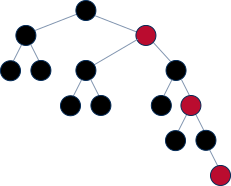 ] -- .rcol[ ### Max height RB tree - Path to farthest leaf can be up to twice as long as the path to the nearest leaf - RB trees are roughly height-balanced! ] ??? - Shortest path has all black nodes - Longest path alternates between black nodes (starting from root) and red nodes (to latest node) --- ## Operations - Just like for AVL trees, query operations are unchanged from normal BSTs - Insertion and removal must be adapted to maintain the red-black properties ??? - Removal is quite complicated, so let's focus solely on insertions -- .lcol60[ ![:newline 1] ## Insertion procedure 1. Regular BST (recursive) insertion 1. Color new node in red 1. Restore red-black properties if necessary - *Recoloring* and *restructuring* - Back up to root 1. Color root in black ] .rcol40[ 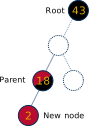 ] ??? - Having to restore properties depends on the color of the parent - 3 different main cases --- ## Case 1: nothing to report ![:newline 1] .lcol40[ 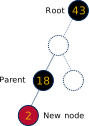 ] .rcol[ - If parent is black, nothing to do! - Red-black properties not violated ![:newline 2] Issues arise when parent is red... ] --- ## Case 2: recoloring ![:newline 1] .lcol66[ ### Before - G is the **black grandparent** - P is the **red parent** - U is the **red uncle** (i.e. the parent's sibling) - N is the node violating the red rule - Newly inserted node or recolored node (from previous recoloring below in the tree) ] .rcol33[ 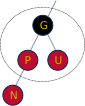 ] ??? - N can be recolored because of previous recoloring operations below in the tree -- ![:flush 1] .lcol66[ ### After - G is recolored into red - P and U are recolored into black ![:newline 1] - Red rule is respected again - Path rule is still upheld ] .rcol33[ 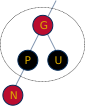 ] --- ## Case 3a: simple restructuring .lcol66[ ### Before - G is **black** - P is **red** - Its right subtree is designated a `X` - U is either **black** or a NIL node - N is the node violating the red rule - Newly inserted node or node changed from recoloring lower in the tree ] .rcol33[  ] -- ![:flush 1] .lcol66[ ### After - Right rotation between P and G - Or left rotation if situation was symmetrically inverted - G inherits P's right subtree as its new left subtree - P is recolored into black - G is recolored into red ] .rcol33[  ] --- ## Case 3b: complex restructuring .lcol66[ ### Before - Same as *Case 3a*, but N is on the **inside** of the subtree under G ] .rcol33[  ] -- .lcol66[ ### After - Double left-right rotation - Or double right-left rotation if situation was symmetrically inverted ] ![:flush] .lcol[  .center.footnotesize[1/ Rotation left] ] .rcol[ ![:newline 3] 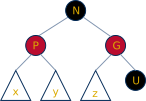 .center.footnotesize[2/ Rotation right and recoloring] ] --- ## Insertion demo .footnotesize[ ```C std::vector<int> keys{2, 18, 42, 43, 51, 54, 74, 93, ...}; for (auto i : keys) { rbt.Insert(i); ``` ] -- .lcol[  .center.footnotesize.red[Insert 2] ] ??? - 2: Violation of root rule - Root recoloring, last step of any insertion -- .rcol[  .center.footnotesize[Root recoloring] ] -- ![:flush 1] .lcol[  .center.footnotesize.red[Insert 18] ] ??? - 18 - Parent is black - Case 1: nothing to report -- ![:flush 1] .lcol[  .center.footnotesize.red[Insert 42] ] ??? - 42: violation of *red rule* - Case 3a: parent is red, grandparent is black, uncle is black -- .rcol[  .center.footnotesize[Left rotation] ] --- .lcol[  .center.footnotesize.red[Insert 43] ] ??? - 43 - Case 2: parent is red, grandparent is black, uncle is red - Recoloring -- .rcol[ 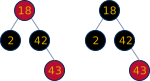 .center.footnotesize[Node recoloring -- root recoloring] ] -- ![:flush 0.5] .lcol[ 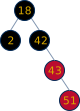 .center.footnotesize.red[Insert 51] ] ??? - 51 - Case 3a: parent is red, grandparent is black, uncle is black - Simple restructuring -- .rcol[  .center.footnotesize[Left rotation] ] -- ![:flush 0.5] .lcol[ 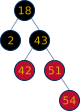 .center.footnotesize.red[Insert 54] ] ??? - 54 - Case 2: parent is red, grandparent is black, uncle is red - Recoloring -- .rcol[ 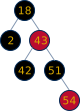 .center.footnotesize[Node recoloring] ] --- .lcol[ 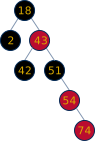 .center.footnotesize.red[Insert 74] ] ??? - 74 - Case 3a: parent is red, grandparent is black, uncle is black - Simple restructuring -- .rcol[ 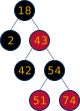 .center.footnotesize[Left rotation] ] -- ![:flush 1] .lcol[ 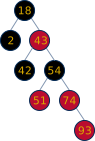 .center.footnotesize.red[Insert 93] ] ??? - 93 - Case 2: parent is red, grandparent is black, uncle is red - Recoloring - Case 3a: parent is red, grandparent is black, uncle is black - Restructuring -- .rcol[ 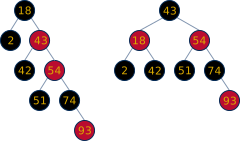 .center.footnotesize[Node recoloring -- Left rotation] ] --- template: title --- layout: false # Recap ## Red-black trees .lcol40[  ] .rcol60[ ### Properties 1. **Color rule:** Nodes are either red or black 2. **Root rule:** Root node is always black 3. **Red rule:** Children of a red node are black 4. **Path rule:** Same number of black nodes between root and nodes of degree 0 or 1 ] -- ![:flush 2] .lcol[ ### Insertion procedure 6. Regular BST (recursive) insertion 7. Color new node in red 8. Restore red-black properties if necessary - *Recoloring* and *restructuring* - Back up to root 9. Color root in black ] .rcol[  ] --- layout: true # Left-leaning Red-Black tree --- ## Definition - Left-leaning red-black trees (LLRB) are a variant of RBTs designed to be easier to implement (Sedgewick, 2008) - Removal operation remains fairly complex - Additional properties: *red nodes are always left children* ![:newline 2] ### Example 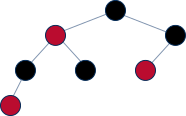 --- ## Implementation: data structure - Based on BST and unchanged for query methods - Node structure increased to contain the color information - A few extra internal methods for self-balancing purposes ![:newline] .lcol60.footnotesize[ ```C template <typename T> class LLRB { ... enum Color : bool { RED, BLACK }; struct Node{ T key; Color color; std::unique_ptr<Node> left; std::unique_ptr<Node> right; }; std::unique_ptr<Node> root; ... // Helper methods for the self-balancing bool IsRed(Node *n); void Recolor(Node *n); void RotateRight(std::unique_ptr<Node> &prt); void RotateLeft(std::unique_ptr<Node> &prt); }; ```  ] -- .rcol40.small[ ```C template <typename T> bool LLRB<T>::IsRed(Node *n) { // NIL nodes are black if (!n) return false; // Regular nodes return (n->color == RED); } ```  ] ??? - NIL nodes are considered black (that's how empty `U` in previous slides works -- for case 3a and 3b) -- .rcol40[ ## Recoloring .footnotesize[ ```C template <typename T> void LLRB<T>::Recolor(Node *n) { n->color = RED; n->left->color = BLACK; n->right->color = BLACK; } ```  ] ] --- ## Rotations - Same as AVL but recoloring management instead of height .small[ ```C template <typename T> void LLRB<T>::RotateRight(std::unique_ptr<Node> &prt) { std::unique_ptr<Node> chd = std::move(prt->left); prt->left = std::move(chd->right); chd->color = prt->color; prt->color = RED; chd->right = std::move(prt); prt = std::move(chd); } ```  ```C template <typename T> void LLRB<T>::RotateLeft(std::unique_ptr<Node> &prt) { std::unique_ptr<Node> chd = std::move(prt->right); prt->right = std::move(chd->left); chd->color = prt->color; prt->color = RED; chd->left = std::move(prt); prt = std::move(chd); } ```  ] --- ## Implementation: insert - Same body as BST - Additional **restructuring** and **recoloring** on the way back from recursion - Always recolor root as black .footnotesize[ ```C template <typename T> void LLRB<T>::Insert(const T &key) { Insert(root, key); root->color = BLACK; } template <typename T> void LLRB<T>::Insert(std::unique_ptr<Node> &n, const T &key) { if (!n) n = std::unique_ptr<Node>(new Node{key, RED}); else if (key < n->key) Insert(n->left, key); else if (key > n->key) Insert(n->right, key); ... if (IsRed(n->right.get()) && !IsRed(n->left.get())) RotateLeft(n); if (IsRed(n->left.get()) && IsRed(n->left->left.get())) RotateRight(n); if (IsRed(n->left.get()) && IsRed(n->right.get())) Recolor(n.get()); } ```  ] ??? - Example inserting: 23, 42, 2 - 23: root recolored in black - 42: insert right, colored in red. matches left rotation on 23. 42 becomes root, and 23 left red child. - 2: insert far left, colored in red. matches right rotation on 42. 23 becomes root, 2 and 42 both red children. then matches recoloring, 2 and 42 become black. --- layout: false # Red-black trees ## Conclusion ### Average and worst-case running times .center[ | Search | Insert | Delete | Find min/max | |-------------|-------------|-------------|--------------| | $O(\lg N)$ | $O(\lg N)$ | $O(\lg N)$ | $O(\lg N)$ | ] ### Characteristics - Slightly less efficient than AVL trees for lookups - At most, height of $2 \log_2(N + 1)$ - More relax balancing which seems to make insertions and removals faster ![:newline 1] - Overall, one of the most popular self-balancing BSTs --- layout: true # Splay trees --- ## Definition - Published in 1985 by Sleator and Tarjan ![:newline 1] - Usual BST operations are combined with a **splay** operation - Splaying brings the accessed node to the root of the tree - Accelerates future accesses to same node or recently accessed nodes ![:newline 1] ### Example `Contains(7)` .lcol[ 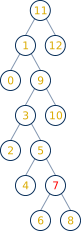 ] -- .rcol[ 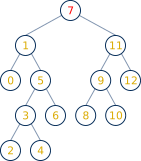 ] ??? - Notice how the tree's balance was improved after the access - Fast access to same node or recently accessed nodes - temporal locality and spatial locality --- ## Conclusion ### Complexity - Average running time: $O(\lg N)$ *amortized* - Any single operation can take up to $O(N)$ ??? - Complexity analysis is difficult because structure changes all the time - But AFAIK, it's been proven - Each access transform the tree, and keeps it somewhat balanced - Any sequence of k operations takes $O(k \lg N)$ worst-case time - Worst-case scenario happens for example when inserting a sequence of ordered numbers -- ![:newline 2] ### Characteristics #### Pros - Excellent performance for scenarios exhibiting *locality of reference* - No extra space required compared to simple BST #### Cons - Poor performance with sorted or random access sequences - Tree structure modified even with read-only operations (i.e. query operations) - *(Makes it difficult to use in multi-threaded programs)* ??? - Apparently used in Windows NT (VM, networking, fs), GCC, stdc++, FreeBSD, etc. --- template: title --- layout: false # Recap .lcol[ ## AVL trees  ] .rcol[ ## Red-black trees  ] ![:flush 2] .lcol[ ## Left-leaning Red-black trees  ] .rcol[ ## Splay trees  ] --- layout: true # B-trees --- ## Introduction ### Scenario .lcol75[ - 26 million drivers in the CA DMV database - DL number (8 bytes) + Record (1 KiB) per driver - Total size of about 26 GiB - Difficult to fit in RAM, needs to be stored on disk ] .rcol25[  ] -- ![:flush] ### Problem .lcol75[ .footnote[.ref[\*] it's more complicated than that... (later in CS153!)] - Disks are slow: about 10 ms per disk access .ref[\*] - Assume local DMV server has 20 users - That is 5 disk accesses/sec per user ![:newline 0.5] - Using a well-balanced AVL tree, height is $\lg(26\*1e6) = 25$ - 25 disk accesses per database access - 5 seconds! ![:newline 0.5] - Question: how to lower the number of disk access? ] .rcol25[  ] --- ## Observations - Height of a *binary* search tree cannot go below $\log_2(N)$ - Compared to disk accesses, machine instructions are free * Assuming a 1GHz cpu, can execute 10 millions instructions within a single 10ms disk access -- ![:newline 0.5] ## Idea Increase arity of tree: - Reduce height to a few levels - More complex but affordable management -- ![:newline 0.5] ## M-ary search trees M-way branching reduces the height to $\log_M(N)$  ??? - This 31 node tree would have had 5 levels as a perfect binary tree --- ## Definition - Published in 1972 by Bayer and McCreight - Generalization of binary search trees with more than two children per node - A B-tree of order $M$ is an M-ary tree with some invariants - Node invariant - Order invariant - Structure invariant ### Example 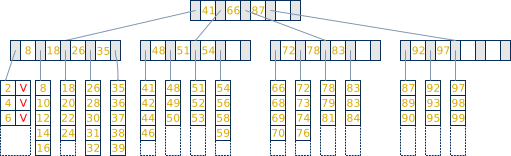 .center.footnotesize[B-tree of order 5] ??? - B in B-trees never explained * Could be Bayer, or Boeing (the company they were working at), or balanced, etc. - Same principle as before: - value associated to key --- ## Node invariant .lcol66[ - Internal nodes - (Up to) $M$ pointers to children - (Up to) $M - 1$ sorted keys ] .rcol33[ 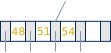 .center.footnotesize[(example with M=5)] ] -- ![:flush 1] .lcol66[ - Leaf nodes - (Up to) $L$ pairs of key-value, sorted by key ] .rcol33[  .center.footnotesize[(example with L=5)] ] -- ![:flush 1] .lcol60[ - Pick $M$ and $L$ wisely - Ideally, have each node fill exactly a page of disk data (e.g. 4 KiB) ] .rcol40[ 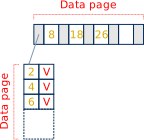 ] -- .lcol60[ - E.g., for CA DMV database: - $L = 4$ (4\*1 KiB per record fits 4 KiB) - $M=256$ (256\*8 + 255\*8 is less than or equal to 4 KiB) ] --- ## Order invariant For any given key $k$, - All subtrees to the left may only contain keys $x$, such as $k > x$ - All subtrees to the right may only contain keys $x$, such as $k \leq x$ ![:newline 1] 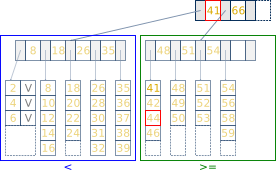 --- ## Structure invariant The overall goal is to keep the tree strictly balanced and avoid any degeneration (e.g. into linked list) ### Root node - Root is a leaf if number of keys is less than $L$ - Otherwise root has between $2$ and $M$ children -- ![:flush 1] .lcol66[ ### Internal nodes - All internal nodes (except for root) have between $\lceil M/2 \rceil$ and $M$ children ] .rcol33[  ] -- ![:flush 1] .lcol66[ ### Leaf nodes - All leaf nodes are at the same depth - And have between $\lceil L/2 \rceil$ and $L$ items ] .rcol33[  ] -- .wide[ - If any node becomes either less than half-full, or full, then restructure tree - Merge or split nodes, or distribute contents ] --- ## Conclusion - Classified as $\lg(N)$ in terms of complexity - Several variants, such as **B+ trees** or **B* trees** - Data structure of choice for certain applications - Databases - Filesystems: Apple's HFS, Microsoft's NTFS, Linux's ext4 ??? - Btree may refer to specific design or general class of designs - In the narrow sense, keys stored in internal nodes, but not in leaves ![:newline 1] - For filesystem, way of mapping files to disk blocks. Given index i of file block, how to locate disk blocks containing the data? --- ### A Special Kind of B-Tree: 2-3-4 Trees - A 2-3-4 tree is an order 4 B-tree. - Each internal node in a 2-3-4 tree has 2, 3, or 4 children, hence the name "2-3-4 tree". - Each node has 1, 2, or 3 keys. - A leaf node in a 2-3-4 tree has no children. - A node with one key is called a 2-node. - A node with two keys is called a 3-node. - A node with three keys is called a 4-node. 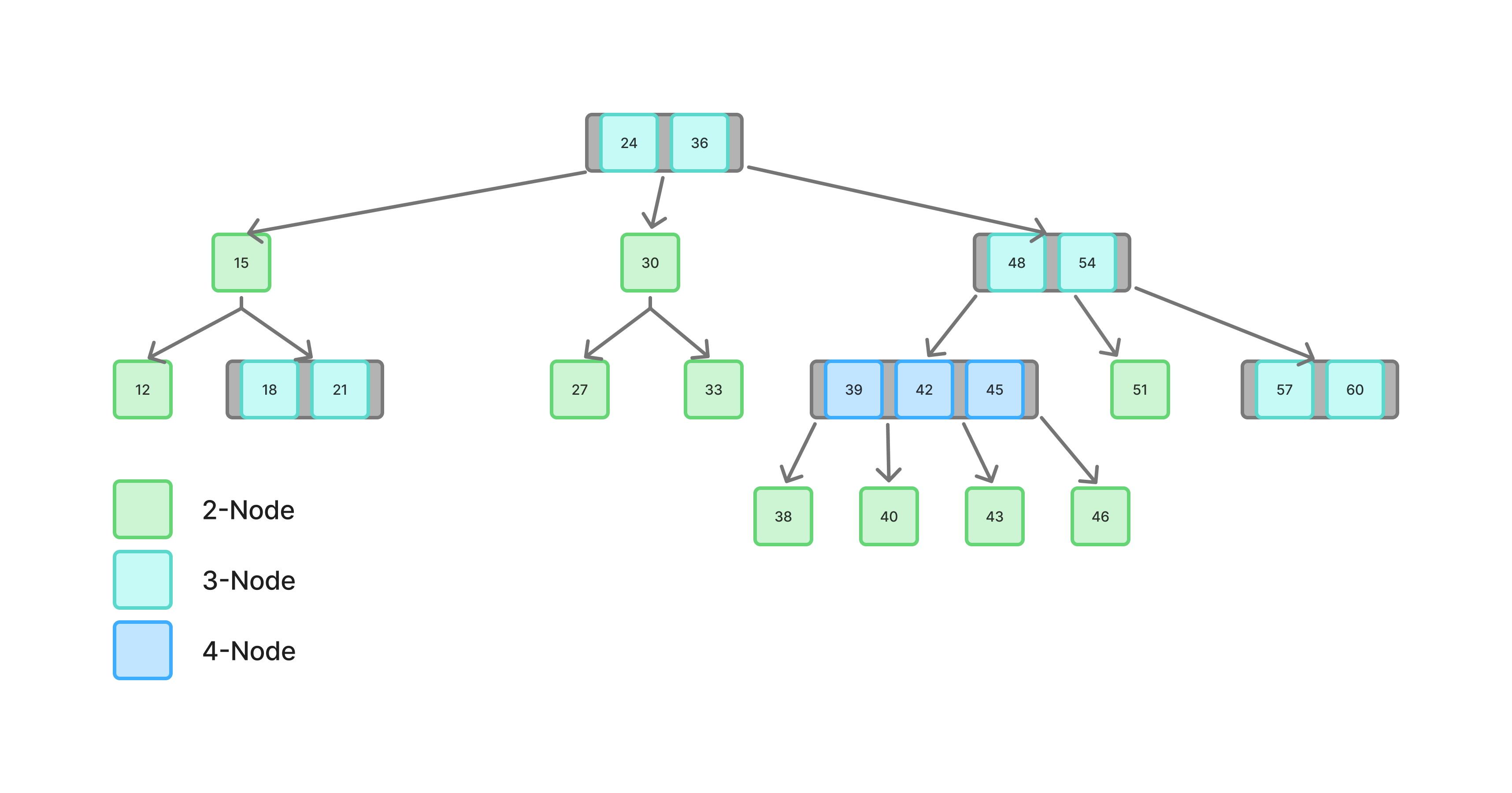 --- layout: true # Standard C++ containers --- The C++ Standard Library defines two main *associative containers*, usually implemented as Red-Black trees: - `std::set` - Contains a sorted set of *unique* objects - Objects must be comparable, as they are used as keys directly - `std::map` - Contains sorted pairs of key-value - Keys must be comparable and unique ??? - multiset, multimap can have multiple items with the same key - `find()` returns an iterator - "unordered" version of set and map are implemented with hashtables -- ![:newline 2] - Comparison with *sequence* containers (vector, list, etc.) - Logarithmic vs linear complexity - More complex to manage (balancing upon insertion/removal) and extra space per stored item (color, pointers to left/right children) - Collection remains always sorted, by design - Collection needs to be "big enough" to justify the extra complexity --- ## Set .lcol66.small[ ```C #include <iostream> #include <set> int main() { // Initialization std::set<int> s = {7, 5, 16, 8}; // Add item dynamically s.insert(6); // Add already existing item s.insert(8); // Iterate and print values for (auto n : s) std::cout << n << std::endl; return 0; } ```  ] .rcol33.small[ ```terminal 5 6 7 8 16 ``` ] --- ## Map .lcol66.footnotesize[ ```C #include <iostream> #include <map> int main() { // Initialization std::map<int, std::string> m = { {36, "Alice"}, {23, "Bob"} }; // Dynamic insertion by indexing m[8] = "Lisa"; // Dynamic pair insertion m.insert({10, "Bart"}); // Alternative pair insertion // and of duplicated item m.insert(std::make_pair(10, "Bart")); // Iterate and print values for (auto n : m) std::cout << "(" << n.second << ": " << n.first << ")" << std::endl; return 0; } ```  ] .rcol33.small[ ```terminal (Lisa: 8) (Bart: 10) (Bob: 23) (Alice: 36) ``` ] --- layout: false # Comparison of self-balancing trees From the general consensus: ### AVL trees - Great if searching is the prevailing operation, because of stricter balance - Insertion and removal can be somewhat slow ### Splay trees - Great if large number of items but only a few are frequently accessed - Poor with random accesses ### Red-black trees - Best compromise - Hence used in most libraries ### B-trees - Great for on-disk data structures ![:newline 1] #### Further info: - <https://web.stanford.edu/~blp/papers/libavl.pdf> - <https://www.google.com/search?q=avl+vs+red+black+vs+splay>